X
 [searchandfilter id="40551"]
[searchandfilter id="40551"]
[searchandfilter id="40551"] 
May 23, 2014



In the new documentary ‘Fed Up,’ author and journalist Michael Pollan reminds us that: “Junk is still junk, even when it’s less junky.” If you want to see what Pollan is talking about, soon all you’ll need to do is walk into a classroom in a low-income school district at breakfast time.
Expand your understanding of food systems as a Civil Eats member. Enjoy unlimited access to our groundbreaking reporting, engage with experts, and connect with a community of changemakers.
Already a member?
Login
At a time when recent gains to the national school lunch program are in danger of being rolled back due to intense pressure from the food industry—a GOP spending bill approved Monday would allow some schools to apply for waivers that exempt them from new rules governing sodium, whole grains, fruits/vegetables, and snacks—it shouldn’t surprise us that most school breakfast offerings are less than ideal.
 But are they better than no breakfast at all? That’s the unexpected question I struggled with after attending a breakfast summit in New York last week.
The summit was designed to educate school leaders in districts with a high percentage of free and reduced-priced meal students, on how to offer breakfast in the classroom. It’s a worthy cause we can all support if the food served can help get kids to start their day on a healthy, nourishing note.
The American Dairy Association and Dairy Council (ADADC) graciously reached out and invited me to the breakfast summit, after I publicly expressed my dismay at their sponsorship of the event. While I’m a fan of healthy dairy products, I do not believe that any food or beverage companies or trade organizations, should sponsor nutrition events. Since their missions are primarily to sell more product, that presents a major conflict of interest (see the “poster child” for these types of conflicts–the Academy of Nutrition and Dietetics). So I attended the breakfast summit, fully expecting to be aggravated with the dairy industry’s marketing.
But, as it turned out, it was the processed food giants, Kellogg’s and General Mills that made my blood pressure skyrocket. At the summit, each company was marketing a line of ultra-processed breakfast foods formulated to meet the new U.S. Department of Agriculture (USDA) school nutrition standards. Think whole-grain Pop Tarts, reduced-sugar Froot Loops, Crunch Mania bite-sized cinnamon buns with whole grains, and lower sugar and whole-grain infused Lucky Charms.
While slightly more nutritional than the original versions, this type of product hardly seems to align with the USDA’s stated intent “to provide healthy meals to children.”

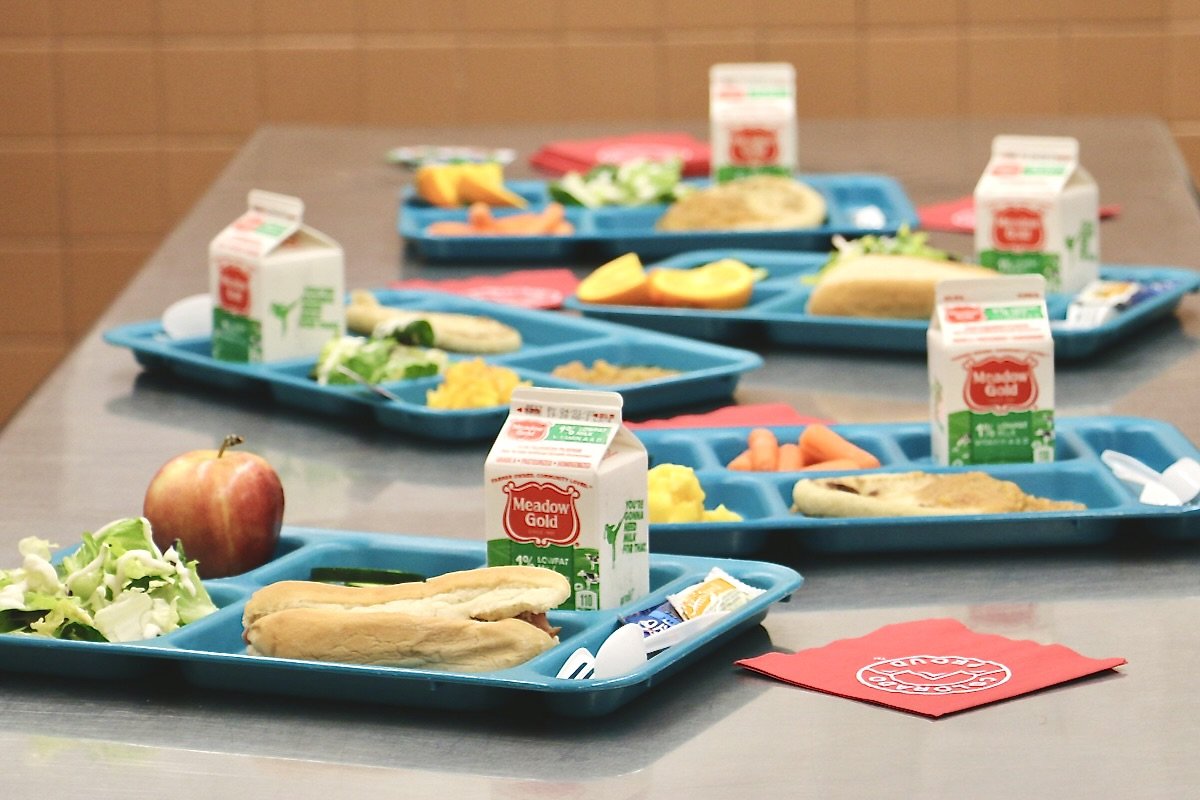
The new guidelines require milk (plain or flavored), one serving of fruit/juice/vegetable, and one serving of grains (half of which must be whole grain). One serving of meat or meat alternate is optional.
Now, Kellogg’s and General Mills are both marketing “grab and go” packs, for breakfast in the classroom or cafeteria, as a complete USDA-approved school breakfast, when served with milk. One Kellogg’s breakfast pack contained multi-grain Frosted Flakes, a pack of Keebler Honey Grahams and a 4.23 oz. box of apple juice while a General Mills pack had low-sugar Cocoa Puffs, Mrs. Pure’s Animal Graham Minis, and a 4 oz. pouch of apple juice.
A child who eats either of these packs, served with chocolate milk (still the preferred milk choice in most schools), would consume over 12 teaspoons of sugar for breakfast –that’s more sugar than you’d find in a 12 ounce can of soda. The American Heart Association recommends that children consume no more than 3-to-4 teaspoons of sugar each day, while teen girls are supposed to have no more than five teaspoons and teen boys 8-to-9 teaspoons daily.
In addition, a newly published meta-analysis found that sugar increases the risk of heart disease, and raises blood pressure, independent of weight gain. So even trim children should avoid sugary breakfasts!
 While most would agree that providing meals for food-insecure kids is crucial to their health, these high-sugar choices seem marginally better than skipping a meal. Even when fortified with whole grains, sugary breakfast fare like this would raise a child’s blood sugar precipitously, causing it to plummet within an hour or two. Eating breakfast like this regularly would encourage insulin resistance (the precursor to diabetes), and the daily blood sugar crash would make it hard for a child to concentrate and learn. Imagine the lucky teachers who get to teach these kids two hours after their sugar-laden, government approved breakfast!
While these specially formulated, lower sugar, whole-grain versions of products like Cocoa Puffs, Pop-Tarts, Lucky Charms, Apple Jacks, Nutri Grain bars, Reese’s Puffs and Frosted Flakes are only available to schools, children eating these versions will surely nag their parents to get the original versions in the store, which are even less healthy.
Margo Wootan, Director of Nutrition Policy at Center for Science in the Public Interest, who was intimately involved in the development of the USDA school meal standards, is concerned about the development. “It troubles me that kids will think that Frosted Flakes are a healthy option, when they aren’t,” she said in a recent email.
And she’s not alone. Just last week, the Environmental Working Group’s investigation of kid’s cereals in the supermarket, found that most have an appalling nutritional profile.
I can only hope that the American Dairy Association and Dairy Council representatives, who advise school districts on their classroom breakfast programs, push for real food such as low-sugar yogurt, fresh fruit, whole grain rolls, low sugar whole grain muffins, low-fat cheese sticks, and plain low-fat milk. (Eggs and whole-grain cereals like oatmeal—with kid-friendly, healthy toppings—would also be fine choices. However none of this may be affordable fare).
But that’s just it. If we can’t afford to provide kids with real breakfast food in the classroom, or even in the cafeteria, maybe we need to go back to the drawing board—or commit to funding the program properly so that schools can serve health-promoting foods. I vote for the latter!

Stories change how we see food — and how we act on it.
From farmworkers to policymakers, Civil Eats lifts up the people building a better food system.
Your gift this season will be doubled through NewsMatch, fueling independent journalism that’s hopeful, honest, and free for all.
Together, we can keep these stories alive — and keep the movement growing.
Give Today.


June 26, 2025
At our latest Civil Eats virtual salon, our team talked about the launch and evolution of the Tracker, a running report on federal actions that affect food and agriculture.
January 20, 2025
July 2, 2025




Like the story?
Join the conversation.
Warning: Undefined variable $aria_req in /srv/users/civileats/apps/civileats/public/wp-content/themes/CivilEats/comments.php on line 16
Warning: Undefined variable $aria_req in /srv/users/civileats/apps/civileats/public/wp-content/themes/CivilEats/comments.php on line 21