Op-ed: The Clear Lake Hitch, and the Tribes That Depend on Them, Face Continuing Threats | Civil Eats STAGING

Op-ed: The Clear Lake Hitch, and the Tribes That Depend on Them, Face Continuing Threats

The endangered fish benefited from last year’s wet winter, but the hitch needs more rainfall—and more support from water agencies and political leaders—to create a sustained comeback.

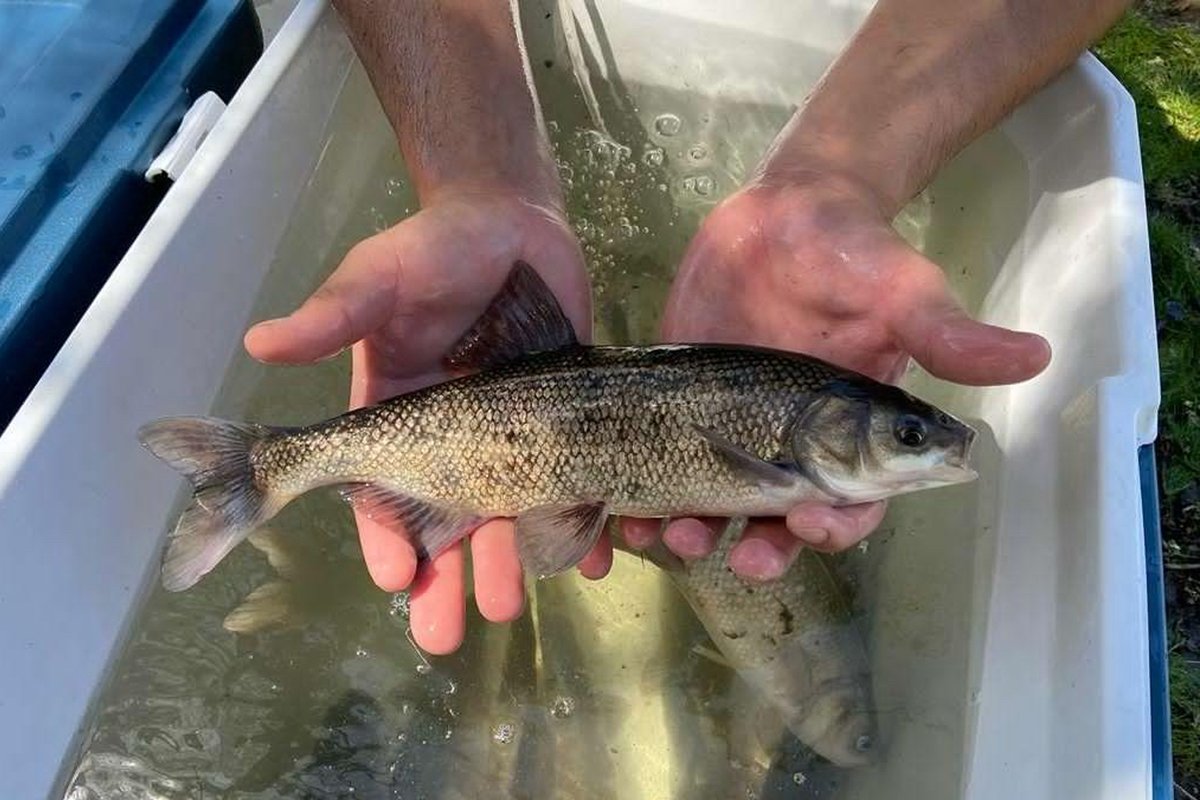
A rescued hitch (Photo credit: Luis Santana)

A rescued hitch (Photo credit: Luis Santana)

A version of this article originally appeared in The Deep Dish, our members-only newsletter. Become a member today and get the next issue directly in your inbox.

Unlock the Full Story with a Civil Eats Membership

Expand your understanding of food systems as a Civil Eats member. Enjoy unlimited access to our groundbreaking reporting, engage with experts, and connect with a community of changemakers.

Join today

One year after California state and Lake County leaders declared an emergency for the endangered Clear Lake Hitch (known as “chi” to local Pomo Tribes), more than a dozen agencies are collaborating in an all-hands-on-deck approach to save this culturally important fish, one intertwined with our destiny as Tribal peoples.

For millennia, abundant spring spawning runs of chi filled 14 tributaries feeding North America’s most ancient lake. Thousands of Tribal members gathered at Clear Lake to communally hand-harvest and process chi into fish jerky that provided year-long sustenance. Following successive genocides of Tribal communities, countless generations of sustainable fish harvests were erased by five generations of environmental damage: water diversions, invasive species introductions, and habitat destruction. Within our lifetimes, the chi spawning runs diminished to only six streams, and throughout the recent drought, we didn’t witness a single run.

“It will take years of juvenile recruitment—loads of healthy teenagers growing into reproductive adults—to ensure their future.”

In 2022, fearing for the chi’s future, Tribal members drove hundreds of miles to testify at agency meetings in Sacramento, Eureka, and South Lake Tahoe. Our efforts inspired a series of historical firsts: interagency hitch summits at Big Valley Rancheria in 2022 and Robinson Rancheria in 2023 resulting in novel, cross-agency collaborations, resource-pooling, and data-sharing to address persistent threats to the chi.

Reversing the damage is a complex undertaking. To understand how to maintain water flows in spawning streams for chi eggs to survive and emergent fry to make their way back to the lake, the California Department of Water and the State Water Resources Control Board are helping to install specialized equipment to monitor surface and groundwater in creeks and creekside wells. Lake County Water Resources and the California Conservation Corps are clearing tons of debris from waterways to improve fish habitat and water flow and reduce streambank erosion.

The U.S. Fish and Wildlife Service and the California Department of Fish and Wildlife (CDFW) allocated millions of dollars to identify and dismantle hitch migration barriers, complete a hitch conservation strategy, and fund the Robinson Rancheria Environmental Protection department to track and remove invasive carp, a chi predator known to grow up to 25 pounds and “vacuum up” thousands of chi eggs and young.

banner showing a radar tracking screen and the words

As we wrote about last year, an exceptionally wet spring in 2023 mitigated California’s drought and brought the welcome surprise of tens of thousands of hitch to lakeside streams. Yet heavy water flows generated a new emergency: Chi were swept over streambanks and stranded in ditches and fields. Tribal staff, accompanied by CDFW and landowners who reported strandings, ultimately rescued more than 26,000 chi.

The sudden appearance of high numbers of chi has scientists scratching their heads—there’s a working hypothesis that adjacent water bodies provided a refuge for adult hitch—and has some local residents, including farmers whose water use has come into question, suggesting that the crisis is not legitimate.

In a public meeting co-sponsored by the Lake County Farm Bureau, the audience was shown graphics illustrating hundreds of sampling sites throughout Clear Lake and nine years of hitch survey data using seine nets, electrofishing, and stream observations by U.S. Geological Service and CDFW fish biologists—all clearly pointing to severe hitch population declines. However, some audience members accused agencies of creating a false crisis based on “faulty data.”

We know that one year of good fish runs doesn’t mean our chi have recovered. It will take years of juvenile recruitment—loads of healthy teenagers growing into reproductive adults—to ensure their future. This year, although another wet winter has brought several feet of rain to Lake County, we haven’t yet seen the kinds of consistent water flows that are needed for the annual upstream migrations of the chi between February and June.

We are still waiting, watching, and praying for our chi. And whenever we see them again, we will sing them home.

We’ll bring the news to you.

Get the weekly Civil Eats newsletter, delivered to your inbox.

Support Civil Eats during NewsMatch

Stories change how we see food — and how we act on it.

From farmworkers to policymakers, Civil Eats lifts up the people building a better food system.

Your gift this season will be doubled through NewsMatch, fueling independent journalism that’s hopeful, honest, and free for all.

Together, we can keep these stories alive — and keep the movement growing.

Give Today.

Civil Eats Supporting Membership $60/year $6/month
Give One, Get One Membership $100/year
Learn more about our membership program

Jeanine Pfeiffer is an ethnoecologist focusing on biocultural diversity: the intrinsic connections between nature and culture. Her award-winning essays, research articles, poems, and films have been nominated for the Pushcart Prize, anthologized, broadcast over radio, exhibited in art galleries, and published in major media outlets, literary magazines, and scientific journals. Read more >

A descendent of the Eastern Pomo Xabenapo village and the Colusa Wintun, Ron Montez Sr. is an enrolled member of the Big Valley Band of Pomo Indians and grew up on Elem Indian Colony, adjacent to the EPA Sulphur Bank Mercury Mine Superfund site. A Pomo Big Head Dancer and Traditional Singer, Ron participated in the 1969 Native American occupation of Alcatraz Island and the 1970 occupation of lands near Forestville, California, now known as Ya-Ka-Ama (“Our Land”). Read more >

Like the story?
Join the conversation.


Warning: Undefined variable $aria_req in /srv/users/civileats/apps/civileats/public/wp-content/themes/CivilEats/comments.php on line 16

Warning: Undefined variable $aria_req in /srv/users/civileats/apps/civileats/public/wp-content/themes/CivilEats/comments.php on line 21

More from

Commentary

Featured

Paulina Velasco from the Institute for Nonprofit News moderated a discussion with Brian Calvert, senior editor, Lisa Held, senior staff reporter and contributing editor, and Matt Wheeland, operations director.

Inside the Food Policy Tracker

At our latest Civil Eats virtual salon, our team talked about the launch and evolution of the Tracker, a running report on federal actions that affect food and agriculture.

Popular

Lorem Ipsum Post

EPA Hires Farm and Pesticide Lobbyist to Oversee Pesticide Regulation

A logo showing the Civil Eats Food Policy Tracker, looking like a radar following food policy proposals and actions

Can This Baltimore Academy Continue to Train Urban Farmers?

Denzel Mitchell at Black Butterfly Teaching Farm. (Photo credit: Sam Delgado)

EPA Funds Projects to Help Farmers Reduce Runoff Into the Great Lakes

A logo showing the Civil Eats Food Policy Tracker, looking like a radar following food policy proposals and actions